What Is Cosmic Timing? The Practical Astrology of When to Act
Here's what cosmic timing is not: predicting your fate, reading your future, or telling you that Tuesday is "lucky."
Here's what it is: using real astronomical data — planetary positions, Moon phases, retrogrades, and aspects — to find optimal windows for action. It's the difference between swimming with the current and against it.
Cosmic timing is the oldest form of applied astrology. Before natal charts became popular, ancient civilizations primarily used astrology for timing — when to plant, when to harvest, when to go to war, when to marry. The sky was a calendar, and reading it well meant better outcomes.
This article is the foundation for everything else on this blog. If cosmic timing clicks for you, every other article becomes a practical tool.
The Core Idea: Timing ≠ Fate
Cosmic timing doesn't say "you will succeed on April 14th" or "avoid October entirely." It says:
Given that you've decided to do something, here's when conditions are most favorable.Think of it like weather forecasting for decisions. You can go for a run in the rain. You can also check the forecast and pick the sunny window. Neither choice is "wrong" — but one is smoother.
The same decision — launching a business, having a difficult conversation, signing a contract — can go very differently depending on when you execute it. Cosmic timing helps you choose the when.
The Four Pillars of Cosmic Timing
1. Moon Phases
The Moon is the fastest-moving celestial body, cycling through all its phases every 29.5 days. This makes it the most immediate timing tool.
The basics:- Waxing Moon (New → Full): Building, growing, initiating. Start new things.
- Waning Moon (Full → New): Releasing, completing, clearing. Finish and let go.
- New Moon: Set intentions, plant seeds (literal and metaphorical)
- Full Moon: Harvest, celebrate, release what isn't working
This alone gives you a powerful framework. Starting a project during the waxing phase and wrapping it up during the waning phase creates a natural rhythm that many people find more productive than arbitrary deadlines.
Read the full breakdown: Moon Phases and Their Meaning
2. Void-of-Course Moon
The void-of-course (VOC) Moon is the period when the Moon makes no more major aspects before changing signs. It happens every 2-3 days and can last from minutes to over a day.
The rule is simple: Don't start important new things during a VOC Moon. Things initiated during VOC tend to not develop as expected — they fizzle, get forgotten, or take strange turns. What's fine during VOC: Routine tasks, meditation, creative play, rest, anything you've already started.VOC is the most underappreciated timing tool in astrology. It's incredibly specific (down to the minute), it's frequent (so you never have to wait long), and it's easy to apply.
Read the full guide: Void-of-Course Moon Calendar 2026
3. Retrogrades
When a planet appears to move backward from Earth's perspective, the areas of life it governs tend to stall, reverse, or require revision.
The key retrogrades for timing:- Mercury retrograde (3x/year): Affects communication, technology, contracts, travel. The most impactful for daily decisions. Full 2026 guide here.
- Venus retrograde (~every 18 months): Affects relationships, finances, aesthetics. Don't get married, launch a beauty brand, or make major purchases.
- Mars retrograde (~every 2 years): Affects energy, motivation, conflict. Don't start lawsuits, launch aggressive campaigns, or begin intense physical regimens.
Retrogrades aren't bad — they're editing periods. The problem arises when people try to push forward during a time that's asking them to look back.
4. Transits and Aspects
Transits are the current positions of planets relative to your natal chart (or relative to each other). Aspects are the angular relationships between planets — conjunctions, trines, squares, oppositions, and sextiles.
For timing purposes:- Trines and sextiles (120° and 60°) = flow, opportunity, ease. Good windows for action.
- Squares (90°) = tension, challenge, forced growth. Not ideal for launching, but great for pushing through obstacles.
- Oppositions (180°) = awareness, confrontation, balance. Relationship themes.
- Conjunctions (0°) = amplification, new cycles. Can be great or intense depending on the planets involved.
The biggest transits of 2026 — Saturn and Neptune entering Aries, Jupiter in Cancer — set the backdrop for the entire year. See our Cosmic Alignment 2026 guide for the full picture.
Putting It All Together: The Cosmic Timing Checklist
When you have an important action to take, run through this checklist:
Cosmic Timing Is Not Astrology for Control Freaks
A common misconception: cosmic timing means waiting for the "perfect" moment and never acting. That's paralysis, not timing.
The reality is:
- Perfect conditions are rare. You'll often need to act during imperfect windows.
- Timing improves outcomes; it doesn't determine them. A great product launched at a bad time still beats no product at all.
- The goal is awareness, not control. Know what the cosmic weather is, then make an informed choice.
Think of it this way: a surfer doesn't control the ocean. They observe the waves and choose when to paddle. Cosmic timing is choosing when to paddle.
Why Real Astronomical Data Matters
Cosmic timing works best when it's based on actual planetary positions, not simplified tables or guesswork. The Moon goes void-of-course at a specific minute. Mercury stations retrograde at a specific degree. These are calculable, precise astronomical events.
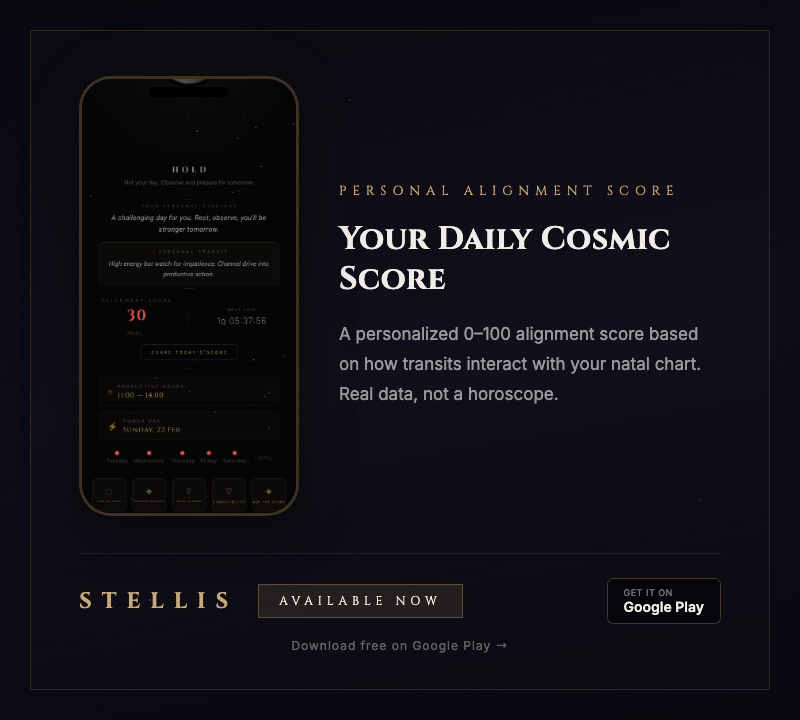
This is why STELLIS uses astronomy-engine — a high-precision astronomical library — to calculate planetary positions, Moon phases, VOC periods, and retrogrades in real-time. No rounded-off dates. No generic "this week" forecasts. Precise timing for your precise decisions.
Start Here
If you're new to cosmic timing, don't try to master everything at once. Start with one habit:
Before any important decision, check if the Moon is void-of-course.That single habit — taking five seconds to glance at your Moon status — will teach you more about cosmic timing than any book. You'll start noticing patterns. Things you start during VOC will feel different from things you start outside it. And from there, you'll naturally want to add Moon phases, then retrogrades, then aspects.
Cosmic timing isn't a belief system. It's a practice. Try it, observe the results, and keep what works.
Explore Further
This article is the hub. Here's where to go next based on your interest:
- Moon Phases and Their Meaning — The 8 phases and what to do during each
- Void-of-Course Moon Calendar 2026 — Month-by-month VOC guide
- Mercury Retrograde 2026: Complete Guide — Dates, shadow periods, and survival tips
- Mercury Retrograde 2026: Signs Affected — Which signs feel it most
- Best Days to Start a Business — Electional astrology for entrepreneurs
- Cosmic Alignment 2026 — The year's major transits
- Best Days to Cut Hair — Lunar timing for beauty
- Natal Chart Houses Explained — Understanding where transits affect you
The cosmos doesn't control your life. But it does set the weather. Cosmic timing is learning to read the forecast — and choosing your moments wisely.