Have you ever had a day where nothing seems to land? You send the email — no reply. You pitch the idea — blank stares. You sign up for something — it falls through within a week.
There might be an astrological reason for that, and it's called the void-of-course Moon.
What Does "Void of Course" Mean?
The Moon moves through all 12 zodiac signs roughly every 28 days, spending about 2.5 days in each sign. As it moves, it forms aspects (angles) to other planets — conjunctions, squares, trines, oppositions.
When the Moon has made its last major aspect in a sign and won't form another one until it enters the next sign, it's considered void of course (VOC).
Think of it as a cosmic intermission. The Moon is still moving, but it's not "talking" to any other planet. It's coasting.
How Long Does It Last?
VOC periods can last anywhere from a few minutes to over 24 hours. Most commonly, they last between 30 minutes and several hours.
Here's the thing — they happen every 2-3 days. This isn't some rare celestial event. It's a regular rhythm that most people completely ignore.
Why Should You Care?
Traditional astrology has a simple rule:
Actions initiated during a void-of-course Moon tend to come to nothing.
This isn't about doom and gloom. It's practical:
- Contracts signed during VOC often need to be renegotiated
- Job interviews during VOC frequently lead nowhere
- New projects launched during VOC tend to fizzle out
- Purchases made during VOC may be returned or regretted
The key word is initiated. If you're continuing work you already started, VOC periods are fine. They're actually great for:
- Routine tasks and maintenance
- Reflection and journaling
- Rest and meditation
- Creative brainstorming (without committing)
- Finishing things you already began
The Science Behind the Tradition
While void-of-course Moon is an astrological concept, the underlying data is real astronomy. The Moon's position and its angular relationships to planets are calculated using precise ephemeris data — the same data NASA uses for space missions.
Whether you believe in the interpretive framework or not, tracking VOC periods gives you a natural rhythm to alternate between action and reflection. And there's genuine value in having designated "don't start anything new" periods built into your week.
How to Track It
Check our complete VOC Moon calendar for 2026 to plan ahead. You have three options:
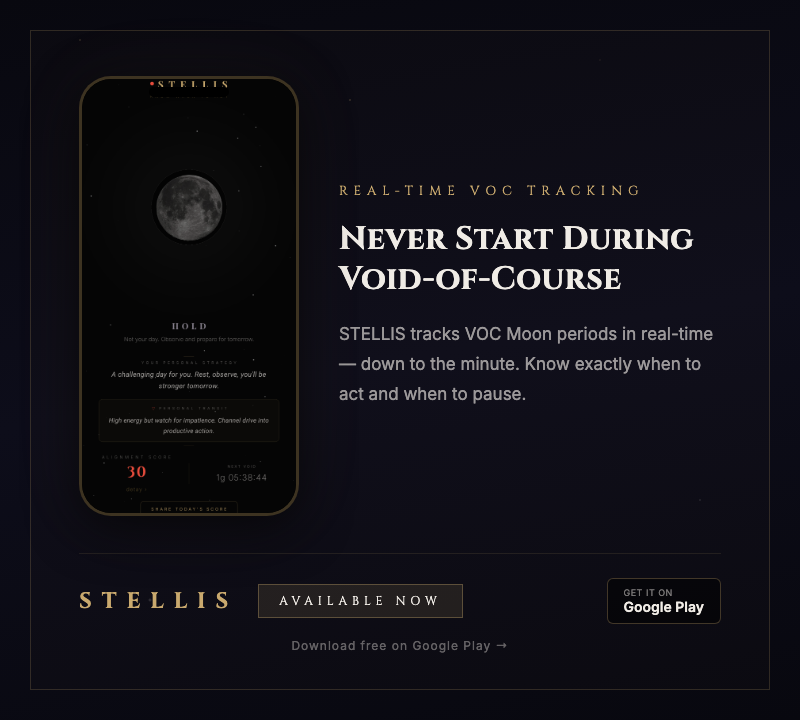
STELLIS calculates void-of-course periods automatically using astronomy-engine (the same library used in planetarium software). It shows you a live countdown to the next VOC period and sends push notifications so you're never caught off guard.
Quick Rules for Void-of-Course Moon
- ✅ Do: Routine work, cleaning, organizing, meditation, creative play
- ✅ Do: Continue ongoing projects
- ❌ Avoid: Starting new ventures, signing contracts, making major purchases
- ❌ Avoid: First dates, job interviews, product launches
- 💡 Remember: VOC ends when the Moon enters the next sign — then you're clear to act
Related Articles
- What Is Cosmic Timing? The Complete Guide
- Moon Phases and Their Meaning
- Full Moon Calendar 2026
- Best Days to Start a Business Using Astrology
The Bottom Line
The void-of-course Moon isn't a superstition you need to "believe in" — it's a timing tool. Just like you wouldn't schedule an important outdoor event without checking the weather forecast, checking the Moon's status before initiating something important is simply smart planning.
The cosmos doesn't control your fate. But it does offer a rhythm. Moving with it instead of against it is what cosmic timing is all about.